
If you thought the rough patches in U.S. factories were temporary, the latest numbers suggest otherwise. The U.S. manufacturing sector has now shrunk for nine months in a row — that’s almost three-quarters of a year of decline.
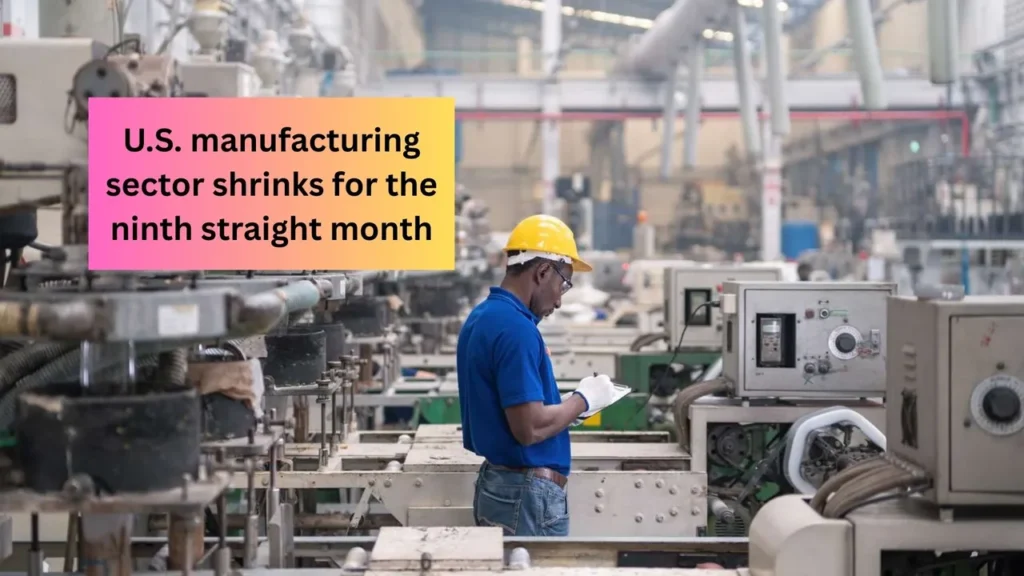
This isn’t just a blip: it’s a trend. The data from November 2025 shows a bleak picture for many factories across America. In this article, I’ll walk you through what the data says, why it matters, and how this might ripple through jobs, prices, and the broader economy.
What the latest report says — The numbers
The headline metric: PMI
Every month, the Institute for Supply Management (ISM) releases its Manufacturing PMI — a snapshot index that tells whether factories are generally expanding (above 50) or contracting (below 50). In November 2025, the PMI dropped to 48.2, down from 48.7 in October. That may seem small, but it confirms that the contraction is continuing.
A PMI below 50 doesn’t just hint at trouble — it signals shrinking industry activity. Nine straight months below that threshold? That’s serious.
Key internal gauges — What’s really hurting
The overall PMI is composed of different sub-indices, and many of them show real pain. Here’s a breakdown:
- New Orders — 47.4: Dropped for the third straight month. Less demand means fewer future factory jobs.
- Employment — 44.0: Factories are cutting or pausing hiring. Many companies are managing headcount instead of expanding it.
- Backlog of Orders — 44.0: Fewer “back-to-back” orders, meaning less work lined up.
- Prices Paid (Input Costs) — 58.5: Materials are getting more expensive — good for suppliers, painful for manufacturers.
- Production — 51.4: This is one bright spot; production ticked up, meaning factories that are still operating made a bit more.
- Inventories — 48.9: Inventories are contracting, but less sharply than before — which may mean firms are holding less stock, expecting demand to remain weak.
In short: orders are weak, employment is down, input costs are up, and factories are trying to produce more — but with fewer orders lined up. That’s a mixed bag at best.
Why is manufacturing weakening? The underlying causes
Tariffs, supply costs and uncertainty
One of the big drivers behind this slump is rising costs — thanks to tariffs and shifting trade policies. Many manufacturers faced higher input costs, making it tougher to maintain profitability.
Uncertainty around tariffs has also disrupted supply chains. As companies worry about what happens next — price hikes, more duties, delayed shipments — they hesitate to commit to new orders or expansion.
Weak demand and cautious buyers
New orders have been shrinking for several months now. That spells weaker demand from both consumers and businesses. When demand is fragile, factories can’t commit to production volumes — and that leads to job cuts and reduced output.
Think of it like a restaurant: if diners stop showing up, even the best chefs and kitchens don’t help — you close early or downsize staff.
Costs rising, but output uncertain — a tough squeeze
While input prices keep rising, the backlog of orders shrinks and hiring stalls. That’s a tough squeeze: expenses up, revenue uncertain. It’s hardly a recipe for growth, more like a pressure cooker.
Add to that shifting global demand and companies looking overseas for cheaper manufacturing — and domestic factories find themselves squeezed from both sides.
What does this mean for the U.S. economy, jobs, and inflation
Jobs — not looking good
With the Employment Index at 44.0, many factories are freezing hiring or laying off workers. That’s a big blow: manufacturing remains one of the major employers in the U.S.
For workers — especially skilled laborers and those in heavy manufacturing — this could mean job instability, wage pressure, or re-skilling needs.
Inflation & costs — rising materials, flat demand
Prices for raw materials are still going up. That might hurt manufacturers’ margins — and if they try to pass this cost to consumers, it could add to inflation. But with demand weak, many firms might absorb the costs instead — which puts pressure on profits.
So what we may get is a weird mix: sluggish demand + increasing prices = maybe mild inflation but squeezed business performance.
Economy-wide ripple effects
Manufacturing doesn’t operate in a vacuum. When factories shrink:
- Suppliers of raw materials and machinery feel the pinch
- Logistics, transport and related industries see lower demand
- Investment and expansion slows down — meaning less capital inflow, fewer new factories, fewer jobs
- Consumer confidence may drop if unemployment rises or wages stagnate
In short: nine months of contraction in manufacturing is not just a factory problem — it could slow down overall economic growth.
Is everything bad? Are there any silver linings?
Some sectors still producing — production index up
The fact that the Production Index (51.4) turned positive is worth noting. It suggests that firms which are operating are trying to keep output up, perhaps fulfilling older orders or streamlining manufacturing.
This could mean that demand hasn’t collapsed completely — or some firms are adapting better, surviving through efficiencies or focusing on niche products.
Possibility of stabilization if costs fall or demand picks up
If input costs ease (raw materials become cheaper) or if demand picks up (domestic or international), there’s a chance manufacturing could recover.
Also, if tariff policies stabilize and trade becomes more predictable, businesses might regain confidence to invest and expand.
Firms may reorient — more efficient, more selective
Sometimes, a downturn forces companies to cut the fat, streamline operations, or shift strategic focus. The firms surviving this contraction might emerge leaner, more efficient, or more competitive globally.
What experts and business-owners are saying
- Several reports highlight that rising tariffs, increased cost of materials, and uncertain trade policies are among the main reasons for persistent contraction.
- A number of manufacturing executives reportedly responded to weak demand by limiting hiring — many are managing head-counts rather than expanding them.
- Some economists suggest that this prolonged slump might drag overall U.S. economic growth down, especially if consumer demand remains lethargic.
It’s not just about individual factories — it’s a broader mood of caution across many industries.
What could change things — and when
Trade policy stabilization or easing tariffs
If trade tensions ease, supply-chain costs could come down, restoring confidence to order more raw materials, expand hiring, and ramp up production. That could reverse some of the contraction signs.
Demand revival — consumer or international
If consumers start spending again — or international buyers ramp up orders — factories will have incentive to increase production and hire again.
Technological shifts, automation, niche manufacturing
Some firms might pivot: using new technologies, focusing on higher-margin products, or shifting to niche manufacturing. That could sustain profitability even if volume remains low.
Government support or fiscal stimulus
Policy support — incentives, tax breaks, infrastructure spending — could inject life into manufacturing and related sectors. Government-level support has historically helped during downturns.
What it means if this continues — a few scenarios
Longer-term stagnation in manufacturing jobs
If contraction continues beyond a few quarters, we might see structural shifts: fewer manufacturing jobs, more outsourcing, and a steady drain on traditional factory-based employment.
Pressure on income growth, consumer demand
Declining jobs and wage pressure in manufacturing could suppress broader consumer spending — which in turn keeps demand weak, creating a negative feedback loop.
Investors and firms becoming cautious — less spending, less expansion
With prolonged uncertainty, firms may avoid investing in new plants, new projects, or hiring — which could mean slower growth in related industries like shipping, logistics, raw-material suppliers, etc.
Possible shift toward services and tech over manufacturing
As manufacturing weakens, the economy could tilt more toward services, tech, and other non-factory sectors — accelerating structural changes in employment and growth patterns.
So — should we panic? Not quite. But it’s a warning
Yes — nine months of contraction is bad news. But the economy is big and multi-dimensional. A slump in manufacturing doesn’t automatically mean recession across the board.
Some sectors (services, technology, digital, etc.) might continue growing. Also, companies may adapt — by becoming more efficient, diversifying, or surviving in niche markets.
Still, this slump is a warning sign: for policymakers, business leaders, workers, and consumers. It’s a sign that structural challenges exist — not just cyclical slowdown.
What you should watch next — key signals
- Next few months’ PMI reports (will the streak end, or get longer?)
- Changes in tariffs or trade policy — any easing could shift the trend
- Raw-material input cost trends — if materials become cheaper, profit margins might improve
- Consumer demand trends — if spending picks up, factories may respond
- Employment data — whether hiring freezes lift or layoffs increase further
These signals will show whether the contraction is a temporary slump or a deeper structural shift.
Conclusion
The news that the U.S. manufacturing sector has shrunk for nine straight months feels like a heavy raincloud hanging over American industry. With new orders falling, employment shrinking, raw-material costs rising — many factories find themselves squeezed from both ends. On the bright side, production ticked up slightly and some firms may be rethinking, restructuring, or adapting.
But this isn’t just about factories — it’s about jobs, economic growth, and how the U.S. economy might evolve in coming years. If nothing changes, this slump could reshape whole sectors. On the other hand, if demand revives, trade policy stabilizes, or companies pivot intelligently — recovery is still possible.
For now, this nine-month streak is a red flag. It’s a sign that the industrial engine is sputtering. And watching what comes next — month by month — might tell us whether it’s a storm or a turning point.
FAQs
Q1: What exactly does a PMI below 50 mean?
A PMI (Purchasing Managers Index) below 50 means that on balance, more purchasing managers in the survey report contraction than expansion. It is widely interpreted as a sign that the manufacturing sector is shrinking rather than growing.
Q2: Does a shrinking manufacturing sector mean the entire economy is in recession?
Not necessarily. The economy is broader than just manufacturing. Other sectors such as services, tech, and consumer goods may still be doing well. However, a prolonged manufacturing slump can weigh heavily on growth, jobs, and related industries.
Q3: Could the manufacturing sector rebound soon?
Yes — if key factors change. For example, if raw-material costs ease, demand picks up, or trade/tariff policies stabilize, factories might regain confidence. Also, firms adapting via new technologies or focusing on niche products may recover sooner.
Q4: What’s the impact on jobs if manufacturing stays weak?
If manufacturing remains weak, many factories might continue freezing hiring or even lay off workers. This can lead to job losses, wage pressure, reduced hiring in related industries (logistics, raw materials, supply-chain services), and long-term structural shifts in employment.
Q5: As a consumer or investor — should I worry?
It’s worth taking notice. For consumers, weaker manufacturing might lead to less job security in certain sectors, which could depress spending. For investors, prolonged contraction may affect companies reliant on industrial supply chains or consumer demand tied to manufacturing output. However, sectors outside manufacturing could still perform well — so diversification matters.