
Will AI take over creativity? Will robots replace artists, musicians, and painters?
These are the questions making waves in today’s creative world. Some people fear a creative apocalypse, while others believe we’re entering a revolutionary new era. But what’s the real story behind AI’s future in art and music?
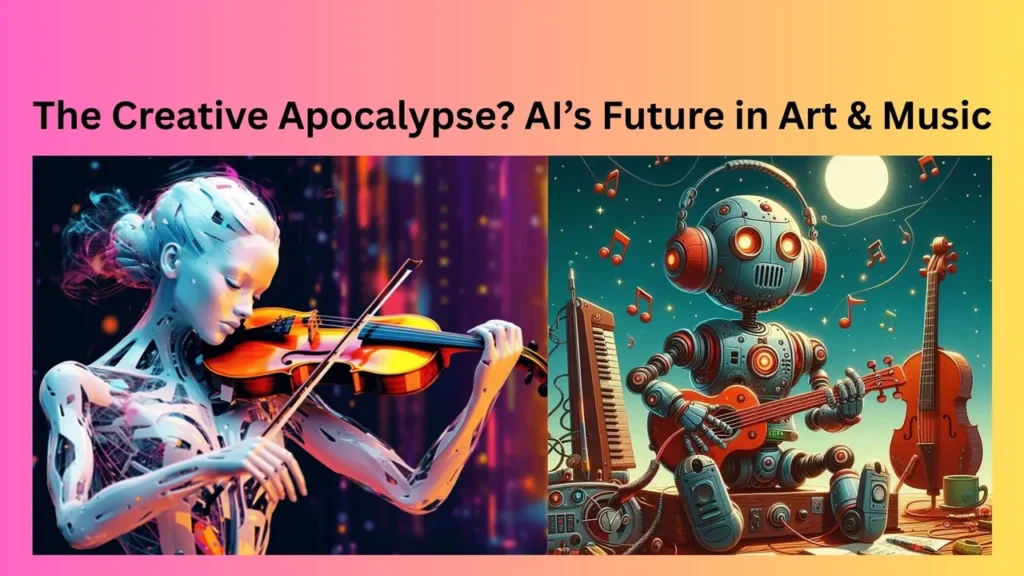
Let’s dive deep into the evolving relationship between technology and the human imagination.
What Exactly Is Creative AI?
Creative AI includes tools that generate or assist in producing creative content:
- Visual art
- Music & soundtracks
- Poetry & stories
- Animation & digital design
They work by learning patterns from existing data and creating something new based on those patterns. It’s like giving a machine a massive art school education in seconds.
The Big Fear: Are Human Artists Becoming Obsolete?
If a computer can paint a portrait in 10 seconds or compose a full song instantly, does that mean artists are out of a job?
Many worry that:
- AI will be cheaper
- AI will be faster
- AI will replace creative professionals completely
But let’s hit pause. Creativity isn’t just speed or output. It’s emotion, intention, storytelling, lived experience. AI can imitate style, but can it feel heartbreak? Can it crave self-expression? That’s where humans still shine.
The Art World’s Biggest Shock: AI Can Make Masterpieces
Tools like:
- MidJourney
- DALL-E
- Stable Diffusion
can create artwork that looks like it belongs in a gallery. Some AI-generated works have even won competitions — and that set off alarms everywhere.
AI Art’s Superpowers
- Unlimited variations
- Rapid brainstorming
- Low costs for concept art
- No technical limitations
But is it truly original if it comes from existing data created by humans?
That’s the ethical argument we can’t ignore.
Music Meets Machines: A New Sound Era
AI isn’t only painting — it’s composing symphonies.
Music platforms like AIVA, Amper Music, Suno, and Jukebox can:
- Generate beats in any genre
- Imitate famous artist voices
- Write lyrics instantly
Why Musicians Are Nervous
Record labels already flirt with AI artists.
Deepfakes can mimic anyone’s voice.
Copyright laws are struggling to keep up.
Imagine your voice being used in a hit song without your permission. Scary, right?
Collaboration, Not Competition
Instead of replacing humans, AI can become a creative partner.
Think of it like having a super-charged assistant who:
- Never sleeps
- Has endless ideas
- Helps execute complex concepts faster
How Artists Use AI Today
- Brainstorming visual concepts
- Enhancing music production
- Designing album art
- Generating inspiration for new directions
It’s the same way photographers embraced digital cameras. Change is uncomfortable, but it often leads to growth.
Human Creativity Still Has the Ace: Emotion
AI doesn’t experience heartbreak, joy, jealousy, or nostalgia.
It doesn’t miss someone. It doesn’t dream.
Those emotions are the secret sauce behind:
- Poetic lyrics
- Powerful performances
- Symbolic paintings
- Cultural movements
AI can copy the form, but not the soul of creativity.
Will AI Kill Originality?
Let’s be real — originality has been evolving for centuries. Artists always build on what came before. AI just speeds up the remix.
But originality still lives in:
- Personal stories
- Cultural identities
- Human struggle and triumph
The future isn’t about protecting originality from AI…
It’s about using AI to push originality further.
The Economics of Creativity: Who Gets Paid?
Here comes the tricky part:
AI learned from existing artworks, but who owns those styles?
Questions we must answer:
- Should artists get compensation if AI uses their work for training?
- Should AI-generated work be copyrighted?
- Who is the real creator — the human prompting or the machine producing?
New laws will shape the future of creative labor.
Education Rewritten: New Skills for Modern Creatives
Traditional artists learned brushes, scales, and composition.
Now, they must learn:
- AI prompting
- Ethical digital production
- Hybrid creativity tools
The next generation of creatives won’t choose between art and technology…
They’ll master both.
Creative Jobs Will Evolve, Not Disappear
Yes, some roles may fade.
But new ones will emerge, like:
- AI art directors
- Machine learning music trainers
- Ethics consultants for digital creativity
- Hybrid design storytellers
When photography arrived, painters feared extinction.
Instead, it unlocked modern art movements.
History repeats… with more code this time.
Will We Still Value Human-Made Art?
Absolutely.
Handmade art, live music, raw talent — these will become even more precious.
People will crave authentic, human-curated work the more AI grows.
Just like handmade crafts still thrive in a world full of machines.
The Future: A Beautiful Chaos
The creative world is transforming rapidly.
Some results will blow our minds.
Some will cross ethical lines.
But creativity has always survived disruption:
- Cameras
- Computers
- Digital synthesizers
Each time, humans reinvented art instead of surrendering it.
AI is just the newest disruptor.
So… Is This a Creative Apocalypse?
No.
It’s a creative evolution.
AI will not destroy human creativity — it will challenge it to grow bolder, more emotional, more meaningful.
Machines can create images and sounds.
But only humans create art that makes people feel alive.
Conclusion
AI is reshaping art and music faster than any shift in history. Some fear the loss of human identity in creativity, but the truth is the opposite — AI is pushing us to define what creativity truly means.
Instead of fighting technology, the future belongs to artists who embrace AI as a tool, not a rival. Creativity won’t end — it will transform, expand, and become more accessible than ever.
There’s no “creative apocalypse” on the horizon.
Just a new chapter waiting to be written — and humans hold the pen.
FAQs
Q1. Can AI completely replace artists and musicians?
No. AI can assist and imitate, but it lacks human emotion, intent, and lived experience — the heart of true creativity.
Q2. Is AI-generated art legal to sell?
Yes, in most countries. But copyright laws regarding training data and originality are still evolving.
Q3. Will creative jobs disappear because of AI?
Some roles may change, but many new hybrid careers will emerge that combine technology with creativity.
Q4. How can artists benefit from AI?
They can use AI for brainstorming, automation, faster production, and exploring new artistic directions.
Q5. Why is human-made art still important?
Human-created work carries stories, emotions, and authenticity — things AI can’t genuinely recreate.