
Artificial Intelligence isn’t just crunching numbers anymore. It’s writing stories, painting portraits, composing music, and even designing fashion lines. Sounds unreal, right? But the future of AI in creative industries is not science fiction—it’s happening right now, and it’s transforming the rules of creativity as we know them.
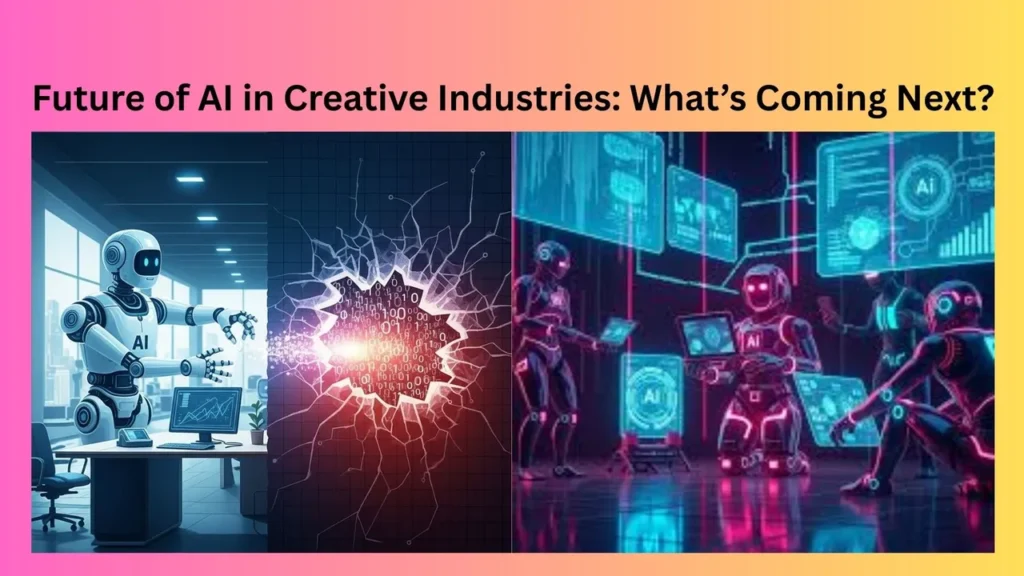
In this article, we’ll dive deep into how AI is shaping the creative world, the opportunities it brings, and the challenges that come along with it. So, let’s explore what the future has in store.
What Do We Mean by “Creative Industries”?
Creative industries include everything built on human imagination and expression. Some key sectors are:
- Film & Animation
- Music & Audio Production
- Writing & Publishing
- Advertising & Marketing
- Graphic Design & Digital Art
- Gaming & Virtual Environments
- Fashion & Interior Design
These fields traditionally relied on human creativity. But now, AI is stepping onto the stage.
How AI Became a Creative Partner
Not too long ago, AI was seen as analytical and boring. Today, tools like:
- Text-to-image generators
- AI music composers
- Script-writing assistants
- Virtual character designers
have turned AI into a co-creator rather than just a calculator.
AI learns patterns from existing content and generates brand-new ideas inspired by what it has learned. Think of it like a supercharged creative assistant that never sleeps and never runs out of ideas.
The Big Advantage: Creativity Comes Faster
Let’s be honest—creative work can take time.
You brainstorm, then scrap your work, then start again.
AI speeds up the process by:
- Offering instant design drafts
- Suggesting better wording for scripts
- Generating multiple artistic variations
- Handling repetitive editing tasks
Instead of replacing artists, AI frees them to focus on the truly creative part.
Future of AI in Film and Animation
Creating Visual Magic With Less Effort
AI can:
- Build realistic CGI environments
- Animate characters using motion prediction
- De-age actors or recreate historical figures
- Speed up editing and sound-sync
Imagine directing a film where the backdrop changes with one command instead of weeks of work.
Scriptwriting That Thinks Ahead
AI tools are helping writers create dialogues, build story arcs, and even detect plot holes.
Soon, real-time storyboarding might adapt to directors’ ideas instantly—like sketching a movie on the fly.
Music and Audio Production: A New Symphony
AI doesn’t just remix—it composes.
Tools can now:
- Write full tracks in any genre
- Design sound effects for games and films
- Personalize playlists based on emotion
- Replicate musical styles of famous artists
Will AI replace musicians? Highly unlikely. But it gives artists new ways to experiment, collaborate, and find inspiration—like a permanent jam partner.
Publishing and Content Creation Get a Boost
Writers already use AI for:
- Brainstorming ideas
- Fixing grammar
- Creating first drafts
- Translating content
In the future, we might have:
- AI that knows your style and tone as well as you do
- Interactive stories custom-built for each reader
- Books that change endings based on user choices—like living novels
Stories won’t just be written — they’ll be experienced.
Advertising: Personalization on Steroids
Marketers love AI, and for good reason.
AI can analyze behavior and create:
- Personalized ads for different audiences
- Visual campaigns in multiple formats instantly
- Trend-based slogans that click with customers
Imagine launching a campaign and having AI design, test, and optimize every version automatically.
This is where creativity meets smart strategy.
Graphic Design and Digital Art: A New Canvas
Design used to require complex tools and hours of precision.
Now?
You describe an idea in text, and AI creates it.
Artists are using AI to:
- Generate quick mockups
- Visualize concepts for clients
- Blend styles that never existed before
AI becomes the brush—but the artist is still the one holding it.
Gaming: Immersive Worlds Without Limits
Games now have:
- AI-built maps and environments
- NPCs that learn and adapt
- Storylines that change based on player behavior
- Hyper-realistic graphics generated procedurally
Future AI could allow players to create worlds with their voice.
Imagine saying: “Build a jungle city with floating temples” — and it appears instantly.
Fashion and Interior Design: Creativity Meets Data
AI can:
- Predict style trends using social data
- Suggest fabric combinations
- Create clothing patterns
- Personalize outfit recommendations
Interior design is also changing:
- Virtual room planners
- AI color-matching
- 3D visualization for any space
The era of guessing what looks good is over.
Collaboration: Human + AI = Super-Creatives
Instead of competing with humans, AI enhances creativity.
Here’s how:
| Human Contribution | AI Strength |
|---|---|
| Emotion | Speed |
| Intention | Pattern prediction |
| Interpretation | Automation |
| Originality | Repetition & scaling |
We think; AI executes. Together, we produce magic.
But There’s a Catch: Ethical Concerns
AI doesn’t come without challenges.
Who Owns AI-Generated Art?
If AI learns from existing works, does it accidentally copy them?
Copyright laws are still figuring this out.
Will AI Take Creative Jobs?
Some roles may shrink, especially entry-level tasks.
But new roles appear:
- AI Creative Director
- Prompt Designer
- Synthetic Media Artist
- Digital Experience Curator
Creativity careers won’t disappear — they’ll evolve.
Authenticity Dilemma
People love art because of human emotion.
Will AI-generated content feel soulless?
The future answer may be: AI provides ideas, humans bring heart.
The Future: Creativity Without Barriers
Here’s what we can expect over the next decade:
- Personalized movies and music generated just for you
- Art tools that respond to your mood in real time
- Virtual worlds where anyone can design like a pro
- AI collaborators that push your creativity further
- Education systems teaching creative AI skills early
Creativity becomes something everyone can enjoy—not just trained professionals.
Will Human Creativity Still Matter? Absolutely
Think of AI as a paintbrush with its own imagination.
But it:
- Doesn’t feel heartbreak
- Doesn’t fall in love
- Doesn’t dream while sleeping
Human emotion will always be the core of great art. AI just helps express it better and faster.
The future belongs to human creators who know how to use AI, not compete with it.
Conclusion
The future of AI in creative industries is not about replacing humans—it’s about upgrading creativity. Film, music, fashion, design, gaming, and advertising are entering a revolutionary era where imagination has no limits.
AI will do the heavy lifting, and humans will do what we do best: feel, imagine, and innovate. Creativity will become more accessible, more personal, and more powerful than ever.
If there’s one takeaway, it’s this: AI is not the end of creativity—it’s the beginning of a creative renaissance.
FAQs
1. Will AI replace human artists?
No. AI is a tool that helps artists create faster. Human emotion and originality remain irreplaceable.
2. Can AI create completely original work?
AI generates new content based on patterns it learns. It can be original, but humans guide direction and meaning.
3. Which creative industry will AI transform the most?
Film, advertising, and gaming are experiencing the fastest changes, but every creative field is evolving.
4. Is AI-generated art legal?
Legal frameworks are still developing, especially regarding copyright and training data.
5. How should creatives prepare for the future?
Learn AI tools, focus on emotional storytelling, and treat AI as a collaborator—not a threat.