
The European defence market has been riding a major wave since the start of the Russia–Ukraine conflict. Defence budgets surged, countries rushed to restock weapons, and investors saw defence stocks as a safe bet. But recently, something unexpected happened: European defence stocks suddenly dropped after news broke about US–Ukraine peace plan talks.
What caused such a swift reaction? Why did markets respond so sharply? And what does this mean for Europe’s defence sector going forward?
In this deep-dive article, we break down everything—market trends, investor psychology, political dynamics, and future predictions. Let’s get into it.
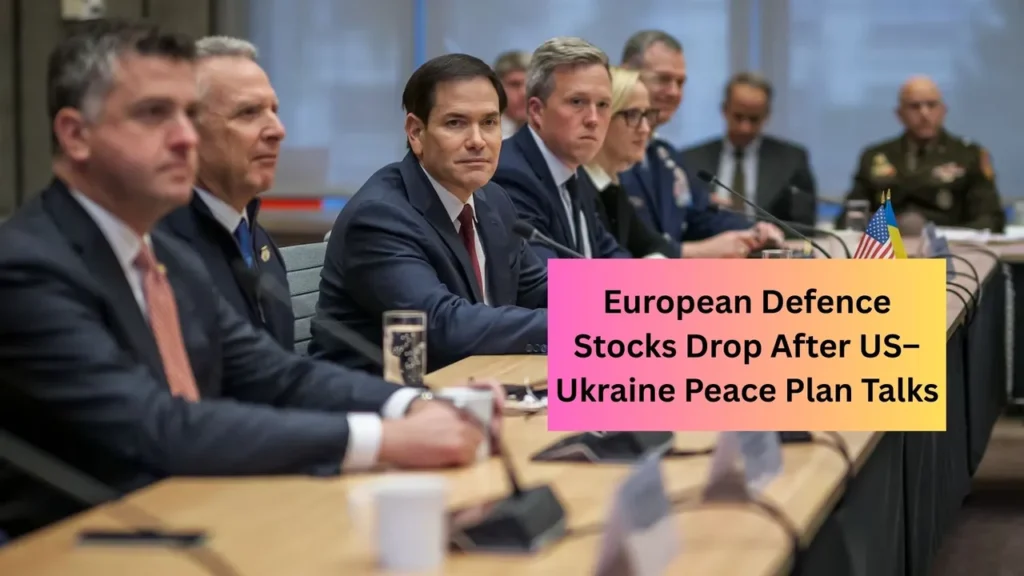
European Defence Stocks Drop After US–Ukraine Peace Plan Talks
Why the Market Reacted So Quickly
Stock markets can be nervous creatures. Even a hint that a conflict may ease can shake sectors that have benefited from wartime spending. When news leaked that the US and Ukraine were exploring elements of a potential peace plan, investors started questioning whether Europe’s massive defence spending spree might slow down.
Defence Stocks Are Sensitive to Geopolitical Shifts
Defence companies thrive in periods when governments feel threatened. When tensions rise, budgets rise. When peace talks begin, spending forecasts get blurry. Investors hate uncertainty.
What Triggered the Immediate Sell-Off?
Reports indicated that US diplomats and Ukrainian officials discussed a framework for peace negotiations. Even though nothing was finalized, the mere suggestion of progress was enough to spark fears among investors that:
- Arms demand could decline
- European nations may reconsider long-term procurement
- Defence production contracts might get delayed
- Stock valuations may have peaked
And just like that, the sell-off began.
A Closer Look at the Numbers
Some of Europe’s biggest defence players saw noticeable dips.
Major Defence Stocks That Took a Hit
While the exact percentages vary by day and region, companies commonly affected included:
- BAE Systems (UK)
- Rheinmetall (Germany)
- Leonardo (Italy)
- Thales (France)
- Saab (Sweden)
Each of these companies saw drops after the peace talk reports surfaced.
Market Analysts’ Quick Reactions
Analysts were divided. Some said the drop was simply a “market correction” after months of steady gains. Others said investors were pricing in the possibility of a slowdown in defence budgets.
Understanding the Peace Talks and Their Impact
This isn’t the first time peace discussions have rattled defence stocks. The market tends to react quickly, even before political negotiations turn into concrete decisions.
What Exactly Did the US and Ukraine Discuss?
According to multiple diplomatic sources, they explored:
- Terms for a ceasefire
- Security guarantees
- Possible territorial compromises
- Long-term reconstruction planning
Nothing was officially agreed upon, but the conversation itself was enough to shift market sentiment.
Why Peace Talks Signal Lower Defence Spending
If the conflict de-escalates, European countries may:
- Reduce emergency military procurement
- Slow down ammunition manufacturing contracts
- Reassess long-term arms investments
- Redirect budgets towards reconstruction or domestic priorities
This creates a potential dip in future revenue for defence companies.
Investor Psychology Behind the Drop
Let’s be honest—investors often move as a herd. When the first sell orders appear, others follow to avoid potential losses.
The Fear of Missing Out—In Reverse
During conflict spending booms, investors fear missing out on big gains.
During peace talks, they fear being stuck with overvalued shares.
Defensive Stocks Are Not Always “Safe”
Contrary to what many assume, defence stocks can be volatile. They react strongly to:
- Government policies
- Peace negotiations
- NATO announcements
- Global diplomatic shifts
This latest drop is proof.
The Political Angle
Peace negotiations are rarely straightforward, and markets often misread political signals.
Europe Isn’t Unified on Defence Spending
Some EU members want peace as soon as possible. Others believe strong defence investment must continue regardless of negotiations. This conflicting stance adds to investor uncertainty.
NATO’s Position Matters Too
The US plays a central role in NATO, so its participation in peace planning carries weight. Markets interpret this as a possible softening of defence postures across Europe.
Will Defence Budgets Actually Fall?
Now, here’s the key question that has everyone guessing: does a peace plan really mean defence spending will drop?
Short Answer—Not Immediately
Even if negotiations begin:
- Europe still needs to replenish depleted supplies
- Defence modernization is far from complete
- Long-term commitments remain active
- NATO allies still consider Russia a major threat
Long-Term Outlook—A Gradual Normalization
Spending may not decrease sharply, but the frantic pace of 2022–2024 is unlikely to continue forever.
Industry Experts Predict a Temporary Dip
Most experts agree that the stock drop is:
- A reaction to headlines
- Not a sign of collapsing demand
- Likely to stabilize when details become clearer
Why This Isn’t a Crash
Defence companies have long-term contracts. Governments don’t cancel billion-euro deals overnight. Many ongoing projects include:
- Fighter jet upgrades
- Artillery production
- Cybersecurity expansion
- Missile system development
Investors May See This as a Buying Opportunity
Some analysts even suggest that the dip could attract long-term investors who believe:
- Peace won’t come quickly
- Defence modernization will continue
- EU threats extend beyond Ukraine
Europe Still Faces Multiple Security Challenges
Even if the war eases, Europe still has geopolitical concerns.
The Rise of Cyber Threats
Cybersecurity is becoming just as important as traditional defence spending.
Tensions With China
Europe’s strategic interests in the Indo-Pacific continue to shape defence policy.
Defence Production Can’t Slow Down Overnight
Manufacturing weapons and military equipment is not like producing consumer goods. Production lines:
- Run on multi-year schedules
- Require massive government partnerships
- Depend on long-term strategic decisions
A short-term news event rarely changes the fundamentals.
NATO’s Long-Term Commitments
NATO members have pledged to keep defence spending at or above 2% of GDP. That means most countries simply cannot afford to cut budgets drastically anytime soon.
What This Means for Investors
Let’s break it down simply.
If You’re a Short-Term Investor
Expect volatility. Market reactions to geopolitical headlines will continue.
If You’re a Long-Term Investor
European defence remains a stable sector with strong government backing and increasing modernization needs.
The Bigger Picture
The stock drop shows how sensitive markets are to diplomatic developments. It also highlights how deeply intertwined politics and defence economics are in Europe.
Could Peace Talks Actually Strengthen Europe’s Defence Industry?
It sounds ironic, but yes. A negotiated peace could give Europe time to:
- Build stronger defence infrastructure
- Standardize equipment across countries
- Expand production capabilities
Peace does not equal weakness—it can lead to smarter long-term planning.
Conclusion
The drop in European defence stocks after US–Ukraine peace plan talks may have rattled investors, but the bigger picture is more complex. While peace negotiations can signal slower spending, Europe’s long-term defence commitments remain strong. The stock decline seems driven more by uncertainty than by real policy changes.
In simple terms: the market reacted to headlines—not hard facts. And until concrete political decisions are made, Europe’s defence industry is unlikely to face a dramatic slowdown.
FAQs
1. Why did European defence stocks fall after the peace plan talks?
Because investors feared that potential peace negotiations could reduce future defence spending, even though nothing concrete has changed yet.
2. Will defence budgets in Europe drop soon?
Not likely. Most European countries still need to rebuild their military stockpiles and fulfil NATO obligations.
3. Are defence companies at financial risk right now?
No. They have long-term contracts and ongoing modernization programs that ensure continued revenue.
4. Should investors sell their defence stocks?
Short-term traders may react to volatility, but long-term investors often hold since defence remains essential for Europe’s security.
5. Is this drop a sign that the war might end soon?
Not necessarily. Peace talks are simply discussions, and conflicts of this scale rarely resolve quickly.