
When former U.S. President Donald Trump talks about foreign policy, people listen—especially when it’s about one of the most talked-about diplomatic deals of the last decade: the Abraham Accords. Recently, Trump made headlines again by claiming that more nations are lining up to join this historic agreement. But what exactly does that mean? And why is everyone paying attention again? Let’s break it down in simple terms.
What Are the Abraham Accords?
Before diving into Trump’s latest claim, it’s important to understand what the Abraham Accords actually are.
In 2020, during Trump’s presidency, the Abraham Accords were signed between Israel, the United Arab Emirates (UAE), and Bahrain—marking a huge step toward normalizing relations between Israel and several Arab nations. Later, Morocco and Sudan also joined the deal.
The idea was simple yet powerful: promote peace, encourage trade, and foster cooperation between Israel and its Arab neighbors—something that had been considered nearly impossible for decades.
Why the Abraham Accords Matter
Imagine two neighbors who haven’t spoken in years suddenly deciding to share a meal together. That’s what the Abraham Accords symbolized for the Middle East—a breakthrough in diplomacy.
The agreement opened doors for:
- Direct flights between nations that previously had no travel ties.
- Trade and tourism that boosted both economies.
- Cultural exchanges and mutual understanding between people who had been separated by politics for generations.
Trump’s New Statement: More Countries Ready to Join
So, what did Trump actually say?
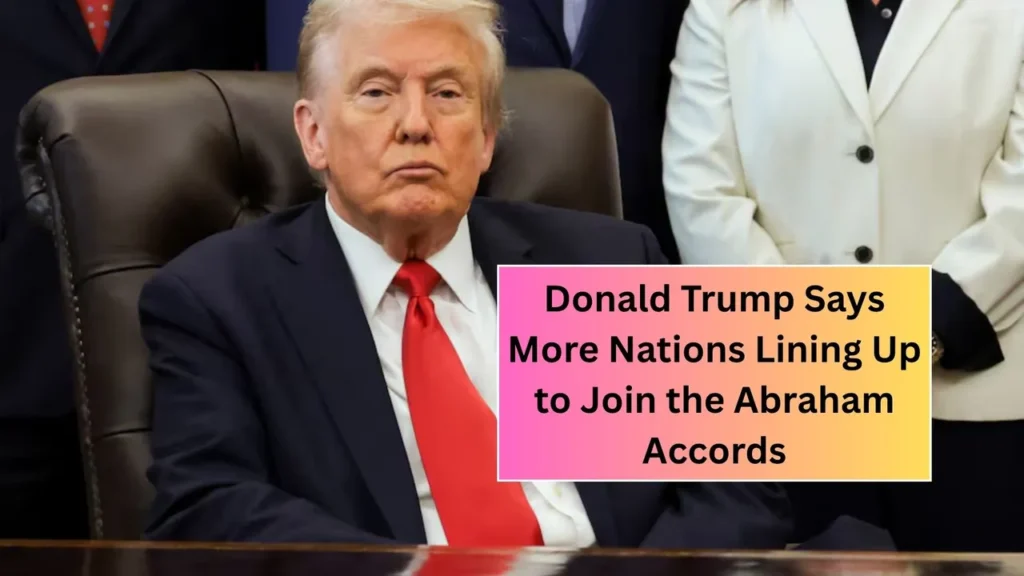
During a recent public appearance, Trump claimed that “many more countries are lining up to join the Abraham Accords.” While he didn’t name specific nations, his statement stirred curiosity and optimism among international observers.
He emphasized that if he were back in office, several additional countries would “sign within weeks.” This suggests that Trump still views the Abraham Accords as one of his signature foreign policy triumphs—and believes there’s unfinished business.
Which Countries Might Be Next?
Now, here’s where speculation runs wild. Although Trump didn’t drop names, experts have their guesses.
Some nations that might be considering joining include:
- Saudi Arabia: Long rumored to be a potential candidate, though still cautious due to internal and regional politics.
- Oman: Known for its diplomatic neutrality and quiet cooperation with Israel.
- Kuwait and Qatar: Still hesitant, but economic incentives could change the game.
- Indonesia: The largest Muslim-majority country, rumored to be in talks at various points.
If even one of these nations signs on, it would mark a major shift in global diplomacy.
Why Would More Nations Join Now?
So why are more countries suddenly interested? The answer lies in shared benefits.
The Abraham Accords aren’t just about peace—they’re about practical progress. Joining the agreement means access to new trade routes, technology partnerships, and defense cooperation.
For many Arab nations, Israel’s technological expertise (especially in agriculture, cybersecurity, and energy) is a huge attraction. Meanwhile, Israel gains new allies and regional stability—something it has long sought.
Trump’s Diplomatic Legacy
Love him or not, Donald Trump’s role in shaping the Abraham Accords can’t be ignored.
Unlike traditional peace processes that dragged on for decades, Trump’s administration took a “deal-maker” approach—focusing on business and economic incentives rather than endless political debates.
That strategy worked faster than many expected. And now, even after leaving office, Trump is leveraging that success to strengthen his political narrative.
How the Biden Administration Fits In
Since Joe Biden took office, the Abraham Accords have continued—but with a quieter tone.
The Biden administration supports the agreement but has focused more on maintaining stability than expanding it aggressively. However, if Trump’s claims are accurate, there may already be quiet talks happening behind the scenes.
Diplomacy often moves like chess—slow, calculated, and strategic. Even if deals aren’t public yet, conversations may already be in motion.
The Global Reaction
Trump’s announcement didn’t just make headlines in the U.S.—it echoed worldwide.
Some saw it as a sign of optimism for peace in the Middle East, while others viewed it as a political move to remind voters of his foreign policy achievements.
Still, the idea of more countries joining the Accords sparked hope among those who believe that peace through economic cooperation is the best path forward.
What Experts Are Saying
Political analysts are divided. Some believe that Trump’s claim might be an exaggeration aimed at boosting his image. Others argue that behind-the-scenes talks with countries like Saudi Arabia are real and progressing.
According to several foreign policy experts, the momentum of the Abraham Accords hasn’t stopped—it has just slowed under new leadership.
Economic Impacts of the Abraham Accords
The benefits of these agreements aren’t just political—they’re deeply economic.
Trade between Israel and the UAE, for instance, has crossed billions of dollars since 2020. Tourism, real estate, and joint ventures have flourished.
If more nations join, the Middle East could transform into a new hub of commerce and innovation—a region defined less by conflict and more by collaboration.
Challenges Ahead
Of course, it’s not all smooth sailing.
The Israeli-Palestinian conflict remains unresolved, and that’s a major sticking point for many Arab nations. Joining the Abraham Accords could be seen as abandoning Palestinian solidarity—a sensitive issue across the region.
Moreover, shifting political leadership in different countries often changes the diplomatic equation. What one leader supports, another may pause or reverse.
Trump’s Confidence: Political Move or Real Possibility?
Let’s be honest—Trump is a master of bold statements. His confidence that more nations are “lining up” might be part strategy, part truth.
It’s possible that some nations have expressed interest privately but are waiting for the right timing or leadership change in Washington before making it public.
In politics, timing is everything.
How These Accords Could Shape the Future
If Trump’s prediction comes true and more countries join, it could reshape the Middle East’s geopolitical map.
Imagine a region where Israel collaborates with most of its neighbors on renewable energy, tourism, and technology. That could mean fewer conflicts, more prosperity, and stronger global alliances.
It would also set a precedent for other regions facing long-standing tensions. Peace, after all, often begins with dialogue—and dialogue begins with deals like the Abraham Accords.
Could This Impact the 2024 Election Narrative?
While Trump’s remarks are about foreign policy, they also play into his political strategy for the 2024 election.
He’s reminding voters of his record—particularly in areas where he delivered visible results. The Abraham Accords are a tangible success story that even critics acknowledge as historic.
If more nations truly sign on in the coming months or years, Trump could use that as proof that his diplomatic style worked.
Final Thoughts: A New Era of Middle East Cooperation?
Donald Trump’s claim about more nations joining the Abraham Accords has reignited global conversation about peace and partnership in the Middle East.
Whether his prediction proves accurate or not, one thing’s clear—the Abraham Accords have already changed the region’s dynamics. What began as a bold diplomatic experiment could evolve into a long-term framework for stability and cooperation.
Only time will tell if more countries truly “line up,” but the very possibility keeps the hope for a more peaceful world alive.
FAQs
1. What are the Abraham Accords?
The Abraham Accords are agreements signed in 2020 between Israel and several Arab nations to normalize diplomatic and economic relations, aiming to promote peace and cooperation in the Middle East.
2. Which countries have already joined the Abraham Accords?
As of now, Israel, the United Arab Emirates, Bahrain, Morocco, and Sudan are part of the Abraham Accords.
3. What did Donald Trump recently say about the Abraham Accords?
Donald Trump claimed that several more nations are preparing to join the accords, suggesting continued momentum for the peace initiative.
4. Could Saudi Arabia be the next to join?
While unconfirmed, Saudi Arabia has long been rumored as a potential next participant, though political and religious factors make the decision complex.
5. Why are the Abraham Accords important for global peace?
They represent a major shift in Middle Eastern diplomacy, showing that former adversaries can work together for mutual benefit in trade, security, and development.