
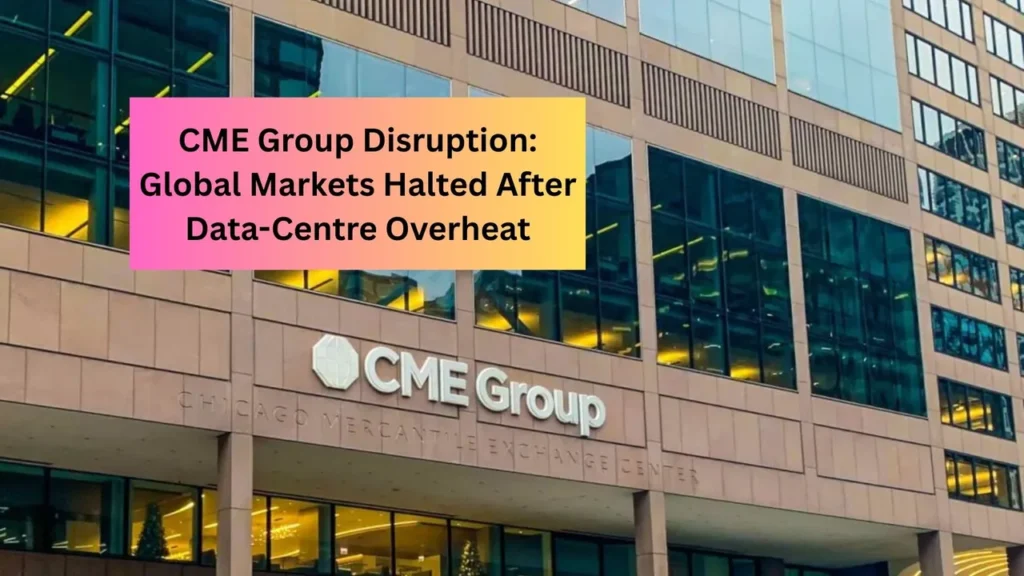
When the world’s largest derivatives exchange suddenly stops working, traders everywhere take a deep breath—and not the good, relaxing kind. The CME Group disruption caused by a shocking data-centre overheating incident brought global markets to a grinding halt. But how exactly did a technical failure manage to freeze a trillion-dollar marketplace? And what does it really mean for traders, investors, and the overall financial ecosystem?
Let’s break it down in the simplest, clearest way possible.
What Exactly Happened at CME Group?
The issue began when a critical data-centre cooling system malfunctioned, causing server temperatures to spike. In response, the system initiated an automatic shutdown to prevent hardware damage. This unexpected shutdown led to:
- Halted futures trading
- Frozen order flows
- Delayed market data
- Widespread connectivity issues
If you’ve ever had your laptop suddenly shut off because it got too hot, imagine that happening—but on a global scale worth trillions of dollars.
Why This Disruption Was a Big Deal
CME Group is the beating heart of global futures and options trading. We’re talking about:
- Crude oil
- Interest rates
- Gold
- Equity index futures
- Agricultural commodities
When CME’s platform stops, the flow of global financial information also stops. Markets everywhere get shaky, uncertain, and confused.
Think of it like a traffic signal in a busy city suddenly going dark—chaos doesn’t take long to show up.
How the Overheating Incident Occurred
So what caused the data-centre to overheat? While the technical investigation is ongoing, early indications point toward:
Cooling System Failure
Mechanical failure in the HVAC cooling infrastructure is the leading suspect. These systems must run with precision—fractions of a degree matter.
Backup Systems Not Kicking In
Most Tier-1 financial data centres have redundancy. But redundancy isn’t magic—sometimes backups fail or take too long to activate.
Power Surge Possibility
A sudden spike in power can cause equipment to heat rapidly, overwhelming cooling infrastructure.
Whatever the exact combination of events, the result was the same—servers got too hot and shut down to avoid permanent damage.
The Immediate Impact on Global Trading
When the CME platform went down, traders across the world were left staring at blank screens.
Here’s what happened next:
Futures Markets Froze
From oil to metals to indexes, major futures markets simply stopped streaming prices.
Volatility Spiked
Uncertainty is a trader’s worst enemy. Without reliable real-time data, markets became extremely sensitive.
Liquidity Thinned Out
Many automated trading systems depend on CME data. No data? No trading. This led to a sharp drop in available liquidity.
Order Execution Delays
Queued orders couldn’t be processed, leaving traders frustrated and financially vulnerable.
How Major Institutions Responded
While individuals scrambled for updates, major financial institutions snapped into crisis mode.
Banks Activated Contingency Plans
Most large institutions maintain backup procedures for market outages. These include:
- Switching to alternate exchanges
- Hedging through OTC trades
- Temporarily halting automated trading algorithms
Brokers Issued Warnings
You might’ve seen messages like:
“CME market data unavailable. Expect delays in order execution.”
Not exactly comforting when millions are on the line.
Trading Firms Monitored Exposure
Without real-time pricing, exposure calculations became harder. Some firms paused risk-heavy activities altogether.
How Traders Reacted
Let’s be honest—no one likes being locked out of the market. Reactions ranged from frustrated to full-on panic.
Manual Monitoring Increased
Without data feeds, many traders relied on news sources, alternative exchanges, and even price estimates.
Some Switched to Crypto
Crypto markets, which rarely sleep, became a temporary safe haven for some active traders.
Hedging Became Complicated
When futures trading stalls, hedging strategies fall apart fast.
Why Data-Centre Failures Are So Dangerous
In today’s hyper-connected trading world, milliseconds matter. The CME outage revealed a harsh truth:
Modern markets are only as strong as their data centres.
High-Frequency Trading Depends on Infrastructure
Algorithms don’t work without data. Even a few minutes of downtime can cost millions.
Global Markets Are Interlinked
An outage in the U.S. doesn’t stay in the U.S.—it ripples across Europe, Asia, and beyond.
Trader Confidence Takes a Hit
When the biggest exchange goes offline, confidence naturally dips.
How CME Group Fixed the Issue
CME’s technical team moved fast—very fast.
Here’s how they restored normal operations:
Cooling Restored First
Before servers could be rebooted, safe temperatures had to be achieved.
System-by-System Restart
Instead of flipping a single switch, components were rebooted in phases to ensure stability.
Integrity Checks Performed
Data consistency checks ensured no corrupted records entered the system.
Communication Issued to Traders
CME sent out status alerts to keep traders updated—though some complained they came too slowly.
Could This Happen Again?
Unfortunately, yes—but the chances are low.
Data Centres Are Complex
Even with redundancies, failures can happen. Machines aren’t perfect.
Climate Change Adds Stress
Higher global temperatures put more strain on cooling systems.
Increasing Trading Volumes
More data means more heat. It’s an ongoing challenge.
What This Means for the Future of Trading
This incident acts as a wake-up call.
More Investment in Infrastructure
Expect CME and other exchanges to invest heavily in cooling, backups, and AI-driven monitoring.
Regulatory Pressure Will Increase
Market regulators don’t like big surprises. Rules around redundancy and reporting may tighten.
Traders Will Look for Alternatives
Decentralized trading systems and blockchain-based settlement might gain more interest.
Lessons for Retail Traders
If you’re a day trader or part-time investor, here’s what to take away:
Always Have Backup Sources of Market Data
Don’t rely on a single exchange stream.
Avoid Over-Leveraging
When markets freeze, highly leveraged positions can become time bombs.
Stay Updated Through Trusted News Sources
Platforms, not rumors.
Keep Calm
Outages happen. Staying calm means staying smart.
Was Anyone Held Responsible?
Investigations are underway, but early signs suggest:
- No cyberattack
- No intentional sabotage
- No negligence
This appears to have been a technical failure—albeit a costly one.
How Much Money Was Lost?
While exact figures are still being tallied, losses include:
- Missed trading opportunities
- Delayed settlement
- Higher volatility premiums
- Potential liquidity impacts
For an exchange that handles trillions annually, even a brief outage can have huge ripple effects.
Could a Data Centre Outage Trigger a Global Crisis?
In extreme scenarios, yes.
Imagine:
- Frozen market data
- Delayed order processing
- Panic-induced sell-offs
While this incident was contained, it shows how fragile the system can be.
Conclusion
The CME Group disruption is a stark reminder of how interconnected—and vulnerable—our global financial systems are. A single overheating incident in a data centre managed to halt futures trading, shake global markets, and trigger widespread uncertainty. While the situation was resolved quickly, it highlighted the need for stronger infrastructure, better backups, and smarter contingency plans.
For traders and investors, the lesson is simple: Always be prepared, because even the world’s biggest exchanges can stumble when technology fails. And as markets grow faster and more complex, having reliable systems and backup strategies becomes more essential than ever.
FAQs
1. What caused the CME Group disruption?
A data-centre cooling system failure led to server overheating, forcing an automatic shutdown of trading systems.
2. How long was trading halted?
The outage lasted several hours, though specific downtime varied across systems and data feeds.
3. Were traders’ funds or data compromised?
No, there is no indication that funds or accounts were at risk. This was a technical failure, not a breach.
4. Could this outage impact future regulations?
Yes. Regulators may push for stricter redundancy and infrastructure requirements.
5. Is CME Group back to normal now?
Yes, operations were restored after cooling systems stabilized and servers were safely rebooted.