
Have you ever wished school could adjust to you instead of making you adjust to school? Imagine a classroom where every student gets a unique learning path, real-time guidance, and constant motivation. That world is no longer a fantasy—it’s happening right now. Welcome to AI-powered personalized education 2026, a future where learning finally becomes truly personal.
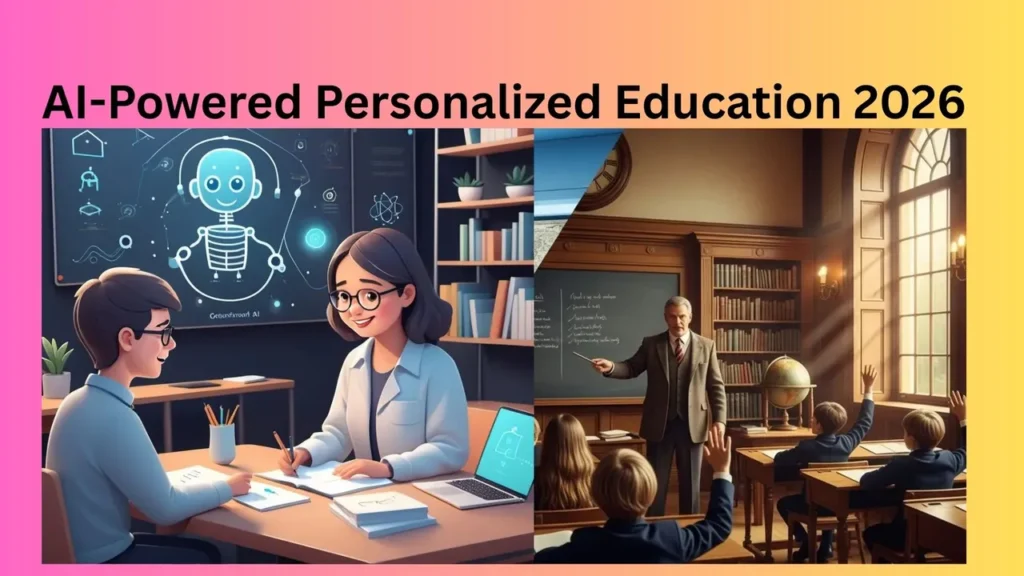
In this article, I’m diving deep into how artificial intelligence is reshaping classrooms, empowering students, supporting teachers, and transforming the entire education system for the better.
Let’s explore what makes this innovation the biggest turning point in modern education.
What Is AI-Powered Personalized Education?
AI-powered personalized education uses intelligent algorithms, adaptive tools, and data-driven insights to create a custom learning experience for every learner.
Instead of one textbook for everyone, students now get:
- Lessons that match their pace
- Content aligned with their strengths and weaknesses
- Real-time feedback to improve instantly
Think of it like having a personal tutor available 24/7—who knows exactly what you need to learn next.
Why 2026 Is the Breakthrough Year for EdTech
We’ve seen online learning, digital classrooms, and smart apps. But 2026 is different.
Here’s why this year is the true game-changer:
- AI tools have become more accurate, powerful, and affordable
- Schools worldwide are adopting AI-driven platforms
- Hybrid learning is now the new educational normal
- Governments and institutions are investing heavily in EdTech innovation
The result? Personalized learning is moving from a luxury to a must-have standard.
How AI Makes Learning Personal
Adaptive Learning Systems
AI evaluates a student’s progress and adjusts:
- Difficulty levels
- Lesson plans
- Practice exercises
If a student struggles with fractions, AI will slow down, explain differently, and offer more examples.
Smart Content Recommendations
Students get videos, quizzes, and explanations based on their learning style. Visual learner? More diagrams. Auditory learner? Engaging voice lessons.
Constant Performance Analysis
The system collects learning behavior data like:
- Time spent on tasks
- Common mistakes
- Skill proficiency
This helps create a clear roadmap for improvement.
Teachers + AI = The Perfect Collaboration
There is a big myth: “AI will replace teachers.”
Absolutely not.
Teachers are irreplaceable. What AI actually does is:
- Reduce workload by automating grading
- Suggest customized teaching strategies
- Track student emotional and mental wellbeing indicators
- Provide insights into individual student needs
Teachers can finally focus on what they do best:
teaching and inspiring, not paperwork.
Breaking Learning Barriers
Every Student Matters
In traditional education, some students get left behind. With AI:
- Slow learners get extra support
- Gifted students receive advanced challenges
- Students with disabilities get tailored accessibility tools
Education becomes inclusive, not forced into one mold.
Learning Anytime, Anywhere
AI-powered apps allow:
- Home learning after school hours
- Remote instruction for rural areas
- Cross-border education access
Learning is no longer confined to the classroom walls.
Real-Time Feedback: The Secret Ingredient
Imagine getting instant corrections instead of waiting days for graded assignments.
AI tools:
- Highlight mistakes immediately
- Provide alternative explanations
- Motivate through gamified rewards
Students improve faster because learning happens in the moment, not after the moment has passed.
AI Tutors: Your New Study Buddy
AI tutoring platforms act like a friendly companion who:
- Answers questions instantly
- Demonstrates practice problems
- Monitors progress daily
Unlike human tutoring, it’s:
- Affordable
- Available 24/7
- Always patient
No more hesitation or fear of asking questions.
Gamification: Making Learning Fun Again
2026 education systems now turn lessons into:
- Mini-games
- Interactive missions
- Reward-based challenges
It encourages:
- Higher engagement
- Longer learning time
- Reduced boredom
Kids suddenly want to study. Magic? No, just smart design.
The Role of Virtual and Augmented Reality
AI joins forces with VR/AR to create immersive learning:
- Explore the human body in 3D
- Walk through ancient civilizations
- Perform chemical experiments safely
History, science, and geography feel like real adventures.
Data Security and Student Privacy
With great technology comes great responsibility.
Schools must ensure:
- Encrypted data storage
- Transparent usage rules
- Parental control access
The goal is learning excellence without compromising safety.
Personalized Assessments: Goodbye Standardized Testing?
Traditional exams judge everyone with the same yardstick.
Now, assessments are:
- Adaptive
- Continuous
- Skill-based
Students are evaluated on what they can actually do, not just what they memorized.
Cost-Effective Education for Everyone
AI tools used to be expensive. Now they’re widely accessible.
Schools save money through:
- Automated systems
- Digital resources replacing textbooks
- Reduced administrative costs
Quality education no longer requires huge budgets.
Preparing Students for Future Jobs
The world is changing fast. AI prepares learners for:
- Digital skills
- Creativity-driven careers
- Real-world problem solving
No more outdated curriculum—education moves with industry trends.
Challenges That Still Remain
It’s not all sunshine.
There are hurdles like:
- Technology access gaps
- Teacher training needs
- Risk of over-reliance on machines
But with ethical use and strong policies, these challenges can be solved.
AI in Higher Education: A New Era Begins
Universities in 2026 now offer:
- AI-guided research support
- Personalized course structures
- Smart mentorship programs
College becomes a journey built around passion, not pressure.
A Learning Experience Tailored to Dreams
Whether someone wants to be a scientist, coder, chef, or dancer…
AI helps design:
- Courses aligned with career goals
- Skill-based certifications
- Portfolio development for job opportunities
Students grow not just academically—but aspirationally.
Conclusion: Education Finally Feels Human Again
AI-powered personalized education 2026 isn’t about robots replacing teachers. It’s about technology helping people learn better. Students feel seen, supported, and understood. Teachers become more empowered. Schools become smarter.
The future of learning is not just digital—it’s personal.
We’re stepping into a world where everyone can learn in their own best way. And that might be the most powerful transformation education has ever seen.
FAQs
1. Will AI-powered education replace teachers in 2026?
No, AI supports teachers by handling repetitive tasks, while educators still guide, mentor, and inspire students.
2. Is personalized education suitable for all learning levels?
Yes, AI adapts to each student’s strengths and weaknesses, making learning easier for slow learners and more challenging for advanced students.
3. How does AI improve learning outcomes?
By giving instant feedback, adjusting difficulty levels, tracking progress, and offering customized resources, students learn faster and more efficiently.
4. Is AI-based education expensive?
It used to be, but in 2026, more affordable AI tools allow schools and families to benefit without high costs.
5. Are there risks to using AI in schools?
Yes—data privacy, digital access gaps, and tech dependency are concerns. With proper safety policies, these risks can be managed effectively.