
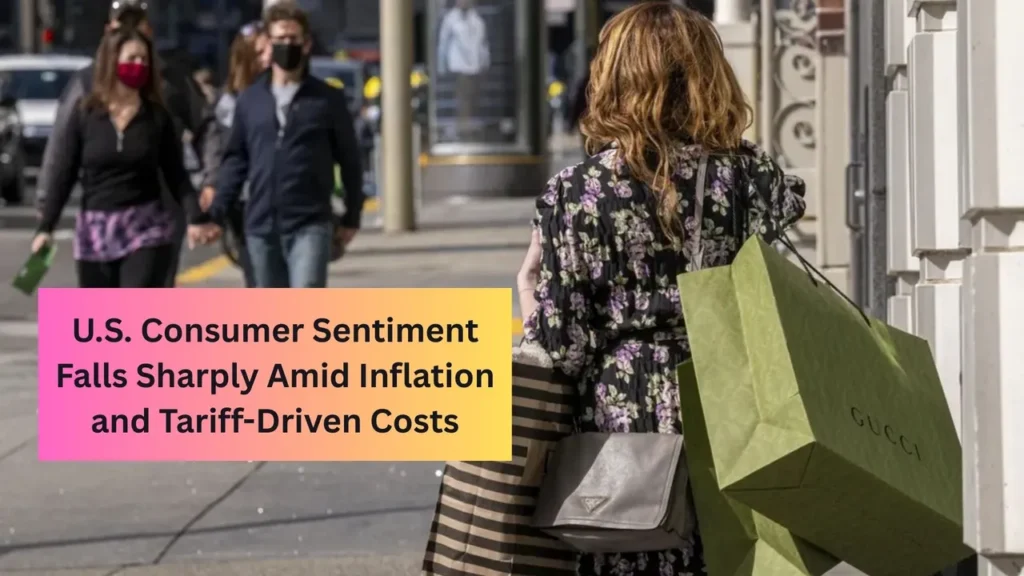
If you’ve been reading the news lately — or even just checking your own monthly bills — you might have noticed something: Americans are feeling uneasy. According to recent data, consumer sentiment in the U.S. has dropped significantly. People are more cautious about spending, more worried about prices, and more uncertain about what the future holds. This shift isn’t random. It’s being driven by two powerful forces: inflation that won’t quit, and tariffs that are increasing costs across the board.
In this article, I’ll walk you through what exactly is happening — why sentiment is dropping, which consumers are most affected, what it means for spending and the broader economy, and what might lie ahead. Let’s dig in.
What Is “Consumer Sentiment” — And Why Does It Matter?
The Measuring Stick: Sentiment Indexes
When we talk about “consumer sentiment,” we refer to how confident people feel about their personal finances, the economy, and what the next few months will bring. One of the main tools for measuring this is the University of Michigan Surveys of Consumers (UMich) Consumer Sentiment Index.
These measures matter — a lot. Why? Because consumers drive roughly two-thirds of the U.S. economy through their spending. If people feel confident, they spend more: they buy cars, electronics, clothing, go on vacations, eat out. If they feel anxious, they pull back, tighten their budgets, and hold off on big-ticket purchases. That ripple effect can shape job growth, retail results, and even influence interest rates or monetary policy.
What Recent Readings Tell Us
In August 2025, the UMich sentiment index fell about 6%, marking the first drop in four months. By November, other sentiment gauges also indicated a sharp decline. December brought a modest uptick — the index rose to 53.3 from 51.0 in November — the overall mood remains gloomy compared with the 71+ reading recorded earlier in the year.
In short: after a brief bounce earlier this year, sentiment is still far below normal, and many Americans remain uneasy.
The Twin Culprits: Inflation and Tariffs
H3: Inflation — Still a Heavy Load
Even though headline inflation has eased from the double-digit spikes seen in 2021–2022, prices remain stubbornly higher than what many households were used to. Things like groceries, gasoline, durable goods (like appliances or electronics), housing — all are still costing more. That ongoing pressure erodes purchasing power, particularly for middle- and lower-income families.
In surveys, a growing share of consumers named “high prices” as the biggest drain on their living standards — the highest number in months. It’s not just a few extra dollars — it’s a worry about whether the cost of “normal life” has permanently changed.
Tariffs — The Hidden Tax on Everyday Goods
Layered on top of inflation is another culprit that might feel invisible until the bill or checkout hits: tariffs. As import taxes on goods rise, many companies pass those costs onto the consumers. Suddenly, everyday items — appliances, electronics, clothing, even parts for cars — become more expensive.
Indeed, in the most recent UMich survey, mentions of tariffs as a negative factor increased: more consumers are blaming tariffs (or “trade environment”) for hurting buying conditions, especially for big purchases such as cars or durable goods. src.isr.umich.edu+1 And those higher tariffs aren’t trivial — estimates suggest households could be bearing a substantial portion of the added costs.
What that effectively does is shrink real income without a wage raise. If your paycheck remains the same but everything costs more, your “budget cushion” disappears.
H2: How Falling Sentiment Affects Actual Behavior
H3: Spending Slows, Especially on Non-Essentials
One immediate consequence of weaker sentiment: consumers pull back on nonessential spending. And that’s exactly what recent retail data shows. In September 2025, core retail sales — which exclude auto, gas, and food services — actually declined. Clothing sales dropped, electronics spending slid, online sales fell. The Economic Times
That means fewer gadget upgrades, fewer wardrobe refreshes, fewer vacations, less dining out. Instead, priorities shift toward essentials — groceries, utilities, basic maintenance, avoiding debt. For many, it’s a “needs vs wants” reset.
Durable Goods and Big Purchases Hit Hard
Durable goods — cars, appliances, furniture — often carry heavy price tags, so when consumers tighten their belts, these are often the first categories to suffer. In the 2025 survey from UMich, buying conditions for durable goods hit their weakest in a year. Car-buying conditions, in particular, deteriorated, with many consumers explicitly mentioning tariff-related price increases as a problem.
For consumers who were thinking about upgrading a car or household item, many have likely postponed or scaled down their plans.
A Softer Labor Market Adds to the Anxiety
It’s not just prices and tariffs dragging down mood. The job market is being watched warily. Some surveys suggest that fewer Americans believe jobs will remain plentiful — or income will grow. src.isr.umich.edu+1 Less confidence in future wages or job security tends to make people hold onto their wallets tighter.
So it’s this three-pronged squeeze: higher inflation, rising cost of imports, and uncertainty about income. That’s a toxic mix when it comes to consumer confidence.
What It Means for the Overall Economy
Slower Growth in Consumer-Driven Sectors
Because consumer spending drives such a large portion of U.S. GDP, a drop in sentiment can lead to slower growth overall. Analysts from Fitch Ratings say that consumer-spending growth is likely to slow in 2025–2026, compared with previous years.
That slowdown could hit industries that rely heavily on discretionary spending — retail, auto, home goods, leisure and hospitality, even certain services. If people are buying less, those sectors suffer first.
A “K-Shaped” Economy — Some Feel It, Others Don’t
Interestingly, not all consumers are affected equally. As spending skimps on non-essentials, higher-income households — who feel the pinch less acutely — might continue spending, especially on services, travel, or luxury goods. But lower- and middle-income households tend to cut back more sharply. That division tends to deepen inequality and creates a “K-shaped” recovery or slowdown, where some recover while others lag behind.
Pressure on Businesses, Job Growth, and Inflation Expectations
Declining spending weakens demand, which can slow business revenue growth. That in turn can affect hiring, wage growth, expansion — creating a feedback loop that further suppresses consumer confidence.
On top of that, when tariffs remain high and inflation sticky, people may keep expecting prices to rise. In the UMich survey, even though short-term inflation expectations recently softened a little (from 4.5% to 4.1%), they remain well above pre-pandemic norms — which keeps consumers uneasy.
H2: Are There Signs of Relief? A Slight Uptick — But Caution Remains
H3: Early December: A Small Glimmer of Hope
In early December 2025, there was a modest revival: the sentiment index climbed to 53.3 from 51.0 in November — slightly above economists’ expectations. On a month-to-month basis, that’s something.
The boost was driven mainly by consumers under 35 and by somewhat improved expectations for personal finances. But—and this matters—the overall context remains gloomy. Income prospects and labor market confidence remained weak, and many still point to high prices as a primary concern.
Why The Improvement May Be Fragile
That small uptick doesn’t mean the underlying challenges are gone. Inflation is still above target. Tariffs remain in place. Wage growth, especially at lower income levels, hasn’t kept up with rising costs. And with economic uncertainty around trade policy and global supply chains, many consumers remain on edge.
If any of those conditions — inflation, tariffs, job prospects — worsen again, sentiment may slip further. In other words: the relief is fragile.
Bigger Picture — What This Means for the U.S. Economy and Policy
Shifts in Monetary and Fiscal Policy
With consumer spending slowing, there may be pressure on policymakers — Federal Reserve in particular — to respond. If inflation remains elevated, but growth slows, the Fed faces a tricky tradeoff: cutting rates might help stimulate spending, but that could also fuel inflation further.
Meanwhile, fiscal policy — tax, tariff, trade policy — will also be under the microscope. Tariffs designed to boost domestic manufacturing may have unintended consequences on consumer costs and spending.
Businesses May Need to Adjust Strategy
Retailers, manufacturers, service providers — many will need to prepare for weaker consumer demand. That could mean scaling back production, delaying expansion, or offering discounts and incentives to attract price-sensitive customers.
Producers importing goods may face pressure to absorb more costs or risk losing consumer demand. Some may even switch to domestic sourcing or streamlined supply chains to avoid tariff impact.
A Potential Long Road to Recovery for Consumer Confidence
Consumer confidence tends to recover slowly — it usually needs stable prices, wage growth, and economic certainty. Until inflation subsides, tariffs moderate or are offset, and jobs feel secure, it’s unlikely Americans will feel comfortable spending again like they used to. It might take months — or even years — for sentiment to normalize.
Why It Feels Personal — What Many Americans Are Experiencing
Shrinking “Budget Cushion”
Imagine your monthly budget as a glass of water. For years, that glass was half full — enough to enjoy some comforts, maybe take a short vacation, eat out. Now, what was half-full is sliding to a quarter-full. Suddenly, a surprise medical bill, a car repair, or a spike in groceries can throw everything off.
That’s the reality many American households are facing. Inflation + tariffs = more expensive basics. A paycheck that once stretched is now tighter. Big purchases that seemed manageable feel risky.
Postponed Dreams and Deferred Plans
People are postponing milestones: a new car, a home renovation, maybe even starting a family. The psychological weight of economic uncertainty can push people to delay big life decisions.
That’s not just bad for individuals — it also reduces demand for products, services, homes, cars. And that can drag on economic momentum.
Uneven Pain — Some Sectors Hurt More Than Others
Lower-income households feel the pinch more sharply than affluent ones. For them, a small increase in grocery bills or utility costs can have a big impact. For higher-income consumers, these increases are easier to absorb. That divergence deepens inequality — even if macroeconomic numbers look “stable.”
Could Things Turn Around? What to Watch
Inflation and Tariff Trends
If inflation begins to ease — thanks to stabilizing energy prices, improved supply chains, or other factors — that could help relieve pressure on households. Likewise, if trade tensions ease and tariffs get rolled back (or if companies find ways to absorb costs), prices could stabilize.
That could give consumer sentiment a shot in the arm.
Labor Market and Wages
If job growth resumes and wages start catching up with cost-of-living increases, households may begin to feel more confident again. For many, a raise or stable employment can do more than any single economic policy.
Clearer Policy Direction and Economic Stability
Clarity — from policymakers on trade, inflation, taxes, interest rates — can help reduce uncertainty. When people feel they have a sense of what’s coming, they are more likely to plan ahead: buy a car, book a vacation, invest in their home.
For now, that kind of clarity remains elusive.
What This Means for Global Observers — Especially Outside the U.S.
Even if you’re not an American consumer, what’s happening in the U.S. matters. The U.S. economy influences global trade, commodity prices, and consumer demand worldwide.
- Slower U.S. spending could weaken demand for imports from other countries.
- Lower demand may impact commodity prices, manufacturing orders, global supply chains.
- Countries that export to the U.S. may see slowed growth or be forced to shift markets.
If you live outside the U.S., it’s worth watching — because ripples often cross borders.
Summing Up the Mood — Why So Much Uncertainty
- Inflation remains high, eating into household budgets.
- Tariffs have increased the cost of many goods, especially imports.
- Consumers have scaled back spending, especially on non-essentials and big-ticket items.
- Labor market trends and income expectations remain weak, limiting optimism.
- While there was a slight uptick in early December 2025, the overall mood remains subdued.
- For businesses, policymakers, and global markets, this could signal a protracted period of adjustment.
All of this adds up to a “new normal” — one where households are more cautious and selective with spending, and where economic growth may slow as a result.
Conclusion
It’s no secret: Americans are feeling the squeeze. Between inflation that refuses to relent and tariffs that have raised the cost of everyday goods, consumer sentiment has taken a sharp hit in 2025. That dip in confidence isn’t just a number — it reflects real changes in how households budget, spend, and plan for the future.
Spending on non-essentials is falling. Big purchases like cars, appliances, and electronics are being postponed. Many families are trimming their budgets just to stay afloat. This shift has major consequences — not only for retailers and manufacturers, but for the broader economy, policymakers, and global trade patterns.
That said, the small rebound in December offers a glimmer of hope. If inflation eases, tariffs moderate, and job and income prospects improve, consumer confidence might gradually recover. Until then, many Americans are navigating a tighter, more uncertain financial path — and adapting their spending to match.
In short: 2025 is shaping up to be a year of recalibration. How long it takes to readjust — and where things go from here — depends less on one single factor and more on the interaction of inflation, trade policy, labor markets, and broader global economic forces.
Frequently Asked Questions (FAQs)
Q1: What exactly triggered the drop in U.S. consumer sentiment in 2025?
A1: The drop was triggered by a combination of ongoing inflation (making everyday goods more expensive) and new tariffs that raised the cost of imported goods. This double burden squeezed household budgets and made many consumers more cautious about spending.
Q2: Does a drop in consumer sentiment always mean a recession is coming?
A2: Not necessarily. While a sustained drop in sentiment can dampen spending — which may slow economic growth — it doesn’t guarantee a recession. Other factors, like government policy, business investment, and global trade conditions, also matter.
Q3: Did sentiment improve at all later in 2025?
A3: Yes — in early December 2025, there was a modest uptick: the sentiment index rose slightly from November. However, the overall mood remained much weaker than earlier in the year.
Q4: Who is most affected by the drop in sentiment?
A4: Lower- and middle-income households tend to feel the impact more sharply, because they spend a larger share of income on essentials and are more sensitive to price increases. Wealthier households, with higher income and savings, may weather the pressure more easily.
Q5: What needs to happen for consumer confidence to recover?
A5: Several things could help: inflation needs to ease; tariffs could be reduced or their impact cushioned; the labor market should improve with better job and income prospects; and consumers need clarity about economic and trade policy. Over time, those factors could restore confidence and gradually bring spending back up.