
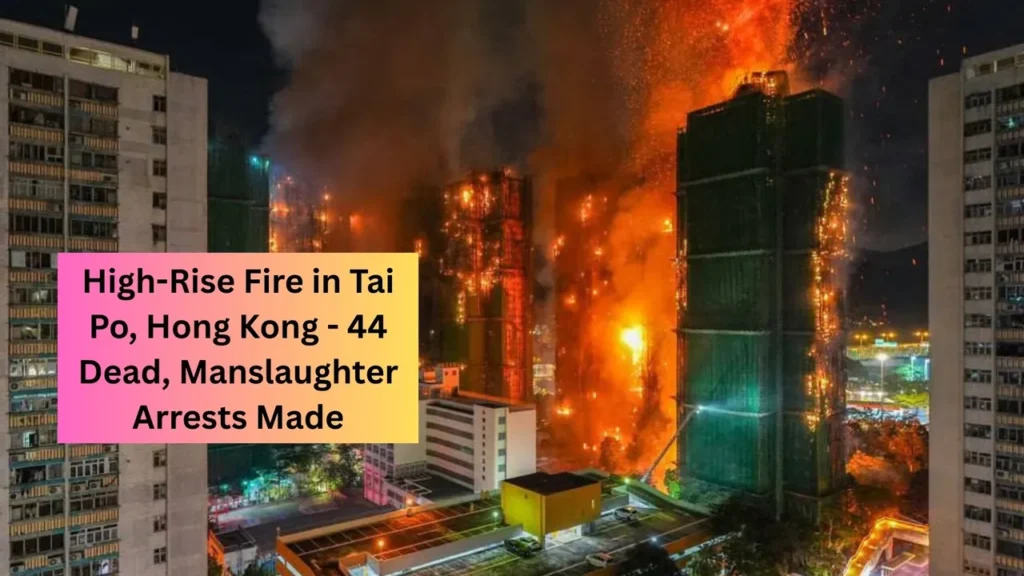
On November 26, 2025, a horrific fire tore through a residential high-rise complex in Wang Fuk Court, located in Tai Po, New Territories, Hong Kong. Flames erupted in the afternoon and rapidly swallowed tower blocks under renovation. Within hours, the fire had become a full-blown disaster. As smoke and fire spread, panic gripped residents. By nightfall, the scale of tragedy was clear: dozens dead, many more missing, and rescue operations stretched to the limit.
But how did a residential building — meant to be home — turn into a fiery trap? Let’s walk through exactly what went down.
Where and When — The Setting
Wang Fuk Court & Its Residents
Wang Fuk Court is a residential estate made up of eight high-rise towers, each roughly 32 storeys tall. The estate housed around 4,800 people across roughly 2,000 apartments.
At the time of the fire, the buildings were undergoing renovation — covered in bamboo scaffolding wrapped with green mesh.
The Ignition — When Did The Fire Start
According to reports, the fire broke out around 2:50 PM on November 26.
It started on the exterior — specifically on scaffolding or netting — before quickly spreading inward and then leaping to neighboring towers.
The Scope of Damage — Deaths, Missing, Evacuations
Confirmed Casualties & Missing Persons
Initial public reports confirmed at least 44 confirmed deaths, including a firefighter.
In addition, 279 people were reported missing as residents, relatives, and rescue teams scrambled through the night.
Hospitals admitted dozens of injured — many suffering severe burns or smoke inhalation.
Rescue, Evacuation and Emergency Response
Over 700 firefighters, dozens of fire trucks, ambulances, and police personnel flooded the area. The blaze was classified a “Level-5 alarm” — the highest alert level under Hong Kong standards.
More than 900 residents were evacuated to temporary shelters set up by authorities. Many more were relocated or remained unaccounted for.
What Went Wrong? — Possible Causes & Safety Failures
Construction Materials & Exterior Scaffolding — A Fatal Cocktail
Investigators found that the buildings’ exterior had been wrapped with bamboo scaffolding and green mesh — common in Hong Kong renovations, but not always fire-safe.
More critically, highly flammable materials such as Styrofoam or foam-board insulation, as well as plastic sheets near elevator lobbies and windows, were reportedly in use.
These materials likely failed to meet fire-resistance standards. The combination of combustible cladding, external scaffolding, and renovation netting created a perfect storm. Once ignited — perhaps by a stray spark or cigarette — flames spread alarmingly fast.
Rapid Spread & Wind Conditions
Once ignited, the blaze didn’t stay contained. Flames leapt from one floor to the next, and from one tower to adjacent ones. Wind reportedly accelerated the spread, helping the fire jump from building to building in quick succession.
By the time fire crews arrived en masse, the fire had already engulfed multiple towers — complicating rescue efforts and evacuation.
Fire Safety Oversight & Negligence — Where Accountability Comes In
Local authorities and police wasted no time pointing at negligence. They believe that key fire-safety standards were ignored: materials used outside the buildings were not fire-resistant, and combustible foam boards were present near elevator lobbies.
There’s suspicion that cost-cutting drove the use of cheaper, unsafe materials and shortcuts in renovation practices. Residents had earlier voiced concern about renovation-related hazards, including the presence of scaffolding and covered windows — but their warnings appear to have gone unheeded.
Legal Fallout — Manslaughter Arrests Made
Who Has Been Arrested
As of Thursday (Nov 27), authorities arrested three men — two directors and one engineering consultant of the construction company responsible for the renovation and maintenance of the complex.
The men are aged between 52 and 68, and the charges are suspected manslaughter — due to “gross negligence” that allegedly led to the deadly fire.
What Police & Authorities Are Investigating
Police said they found flammable foam boards sealing elevator-lobby windows floor by floor, plastic sheeting or netting on exterior walls, and other materials that likely failed to meet fire-resistance regulations.
They are also examining whether renovation permits and inspections were properly obtained and executed, and if shortcuts — possibly driven by cost or corruption — contributed to unsafe building conditions.
The Human Cost — Lives, Families, and a Community in Shock
Residents, Families, and Loss
Imagine being at home, perhaps preparing dinner on a quiet Wednesday afternoon — and suddenly seeing flames licking up outside your building. For hundreds of families, that became reality. Many lost loved ones; others remain unsure whether family members are safe or missing.
Long-time residents of Wang Fuk Court describe the tragedy as a nightmare. Elderly folks, families with children — all caught off guard. Many apartments were sealed for renovation, windows covered, escape routes unclear. As one resident reportedly said: alarms didn’t go off; people only knew to run when neighbours shouted warnings.
For one firefighter, the tragedy hit hardest — he died in the line of duty trying to save others.
Displacement & Shelter Crisis
With hundreds evacuated, shelters quickly filled up. Temporary accommodations were set up, but the scale of displacement was massive — many residents had nowhere to return for days.
Some of the displaced residents face an uncertain future: their homes lost, possessions gone, memories burned. Trauma, grief, and fear for the future now cloud what once was “home.”
Aftermath & Response — What Comes Next
Government Response & Safety Inspections
The fire has triggered a full-scale review of building safety standards citywide, especially for ongoing renovations. Authorities have pledged to inspect all similar housing estates undergoing maintenance or covered in scaffolding.
There is growing public pressure to end the use of bamboo scaffolding and flammable netting, replacing them with safer, fire-resistant alternatives. Many point out that what was once considered a “normal” renovation practice may now cost lives.
Legal & Regulatory Consequences
With three arrests already made on suspicion of manslaughter, the case could lead to stricter enforcement of fire-safety regulations, tougher penalties for negligent renovations, and better oversight on material standards.
Moreover, the scandal has ignited debate about accountability — from contractors to regulators — and sparked demands for transparency in building maintenance records, renovation permits, and fire-safety compliance.
Public Outcry & Demand for Reform
Citizens, civil society groups, and affected families are calling for justice — not just for the victims, but for systemic change. There’s anger about long-standing lax safety enforcement, unchecked renovation practices, and potential cost-cutting at the expense of human life.
Some compare this disaster to prior high-rise fires globally that exposed similar safety failures — a harsh reminder that affordable housing should never come at the cost of safety.
Why This Fire Hit So Hard — A Perfect Storm
Dense Population + High-Rise Living
Wang Fuk Court was home to thousands — families living in the close quarters typical of Hong Kong. High-rise living offers convenience and compactness, but in disaster situations like fire, that density becomes a serious vulnerability.
When fire spreads quickly through multiple floors and towers, escape routes narrow, stairwells fill with smoke, and rescue becomes nearly impossible for many. The more people packed into a high-rise, the greater the risk when safety fails.
Renovation Shortcuts + Flammable Materials = Disaster Waiting to Happen
Renovation is meant to improve, not endanger. But when builders use cheap materials, skip fire-safety checks, and wrap buildings in flammable nets and scaffolding — all potentially to cut costs — the result can be catastrophic.
In this case, what may have seemed like innocuous renovation safety nets and scaffolding turned into kindling. A small spark — maybe a cigarette, or a welding torch — and the entire building became a death trap.
Lack of Preparedness & Weak Oversight
If alarms didn’t function or safety inspections weren’t thorough, residents had no warning. Escape routes may have been blocked or unclear. Without robust enforcement and oversight, even well-meaning renovations can become lethal.
This fire reminds us: building codes, safety standards, fireproof materials — these are not optional extras. They are essential lifelines.
What Could Have Been Done — Lessons & Preventive Measures
Mandatory Fire-Resistant Materials for Exterior Renovations
Municipal authorities should mandate the use of fire-resistant scaffolding, netting, and insulation materials — especially for high-rise buildings. No compromise.
Rigorous Fire Safety Inspections & Compliance Checks
Any renovation should trigger a fire-safety audit and compliance check before approval. Periodic inspections during and after renovation must be mandatory.
Proper Resident Alert Systems & Emergency Planning
Buildings should have functioning fire alarms, clear emergency exits, and regular drills. Residents must be able to evacuate quickly and safely, even in worst-case scenarios.
Accountability — Legal & Administrative — for Violations
When negligence leads to loss of life, there should be real consequences: criminal charges, heavy fines, suspension of licenses, and structural audits for other buildings under the same contractors.
The Bigger Picture — Urban Living, Renovation Culture, and Risk
This tragedy isn’t just about one estate. It’s about how we treat aging urban housing, how we balance renovation with safety, and how regulations must evolve with population density and building practices.
Cities like Hong Kong — with their rapid growth, limited space, and constant need for renovation — must adapt. Safety standards that worked decades ago may no longer suffice. And as populations climb, the margin for error shrinks.
This fire serves as a heed-a warning: without vigilance, cheap shortcuts, and lax enforcement, the consequences aren’t just structural — they’re human.
Conclusion
The high-rise fire at Wang Fuk Court in Tai Po is a tragedy of tragic proportions. What began perhaps as a routine renovation ended in unimaginable loss — dozens dead, hundreds missing, many more displaced. The involvement of flammable materials, potentially negligent renovation practices, and weak fire-safety oversight has sparked anger, grief, and demand for justice.
But beyond the grief lies a crucial lesson for urban centres everywhere: in our rush to modernize, renovate, and build, safety must never be compromised. The lives lost in this fire demand accountability — and change. May we honour them by making sure no building becomes a death trap again.
FAQs
Q1: What was the immediate cause of the fire in Tai Po?
The fire reportedly began on the external scaffolding and renovation netting surrounding one of the towers. Investigations found flammable foam insulation and plastic sheeting near elevator-lobby windows — materials that likely failed fire-safety standards and enabled the fire to spread rapidly.
Q2: How many people died and how many remain missing?
At the time of initial reporting, at least 44 people had died (including a firefighter), and approximately 279 persons were declared missing.
Q3: Who has been arrested in connection with the fire, and why?
Three individuals — two directors and one engineering consultant of the construction firm handling the renovation — have been arrested on suspicion of manslaughter. Authorities believe gross negligence and the use of unsafe materials contributed to the fire’s deadly spread.
Q4: What systemic changes are being proposed to prevent such disasters in future?
Officials plan citywide inspections of all residential buildings undergoing renovation, stricter enforcement of fire-safety codes, replacement of bamboo scaffolding/netting with fire-resistant alternatives, and more rigorous oversight of renovation contracts and materials.
Q5: How has the tragedy impacted public sentiment and trust in building safety standards in Hong Kong?
The fire has ignited widespread public anger and grief. Many citizens — especially those in older high-rise estates — are now questioning safety standards, renovation practices, and regulatory oversight. There’s increasing demand for transparency, accountability, and reform to ensure housing safety is not compromised for cost or convenience.